Monday, August 04, 2014

What goes up, must come down - Part IV

On the occassion of my driving up my second 14k feet peak at Mt. Evans in Colorado, I felt it only appropriate to complete the story of my first 14k peak - a story from more than thirteen months ago, but one that remains fresh in memory like it happened yesterday. Part III of that story can be found here, and Parts I and II are linked from Part III, so let me not make this a link-fest. All that said, here goes...
 
We were still catching out breath in the trekker's shelter at Dronagiri, ready to settle in for a night in a solid structure after two nights in a canvas tent, when our still-active treak leaders informed us that it would probably not be the best idea to sleep in that shelter for the night. We had abandoned our sleeping bags, tents and any other item that could provide us warmth at the base camp. We would freeze through the night if we tried sleeping in our jackets, in that non-insulated building on a concrete floor. Seeing as there was no arguing with that logic, the next natural question then was "Where then?". 
 
The answer - in the stables of the kindly old man who had lent us the mules for the trip. And thus the 14 of us piled into the 'upper floor' of his house, if it could be called that, in an area of approximately 10 feet by 8 feet, and were greeted by the heavenliest item that we could hope to find after three wet, shivering days in snow - a little wood fire burning merrily in the center of the room. At that moment, we realized what the first man who managed to make fire felt like. Short of jumping into the fire itself, we managed to dry ourselves off, and crept down into the stables, which was basically a hole cut into the mountainside. In another display of optimal packing (and reduced sensitivity to smells) we drifted off while overhearing the locals tell our guides about how the mandir doob gaya. They were of course, talking about this, but we had no idea at the time.

The next day - June 18th dawned bright and sunny, almost in mocking contrast to the misery of the previous three. And we slowly started to piece together the true scale of the destruction that had actually happened over the past three days. While we had been snowed in for 48 hours, the parallel mountain range had been practically wiped out in a series of cloudeburst-flooding-landslide events. This also explained the strange looks we had got from the locals the previous night. "You were the ones that were stuck in the snow?, they asked. "We didn't expect you back". The true nature of what we had survived was just beginning to sink in. 
 
We didn't start our descent to Jumma as planned on the day, because the landlides had wiped out our original route. So while the guides explored other routed down the mountain, we pottered about with the locals, learning card tricks and eating raw potato with this simply amazing concoction that we ended up calling Dronagiri Masala. After another night of drying out shoes, socks, gloves and hats, as well as generally returning to a state of wholesomeness under the completely inviting hospitality of people who themselves did not have much to begin with, we were told that we were ready to go the next day. There was a path down - it would involves a few points of inching along on a ledge about a foot wide, and a few points of jumping across 'minor' chasms, but there was a path. Of course we were gonna go for it.

Not that we jumped across that. We just weren't photgraphing cliff-hanger moments
Apart from the mild acrobatics, which again we megotiated quite succesfully for a group of novices, the rest of the descent went by without much drama (relatively, of course). The thing with the descent is that it is much harder on the knees, since you are constantly landing on the knees to 'brake' so that you don't go too fast. However, those nuanced fitness reasons were far from our mind as we took all the assistance that gravity provided us to quicken out pace. We reached Ruing, the point of our first stop when we were climbing by mid-day, and took a little breather. We were finally back in reasonable weather and got our first chance to evaluate the condition of mind and body. Satisfied that they were all fine, we continued our half-walk, half-stumble back down to the roaring Dhauliganga, which was certainly fuller and faster now than we remembered it going up.
 
Bridge. River. Kwai etc. Also you can see 'Jumma', the bus stop
After succesfully negotiating this last bridge and the last climb, we reached Jumma, the point till which we had previously had mechanized transport. However, the landslides had meant that there was now a portion of the road almost exactly halfway to Joshimath, that had been rendered non-motorable, hence leaving us with a three-part journey. The first, piled into the back of an open-top convertible as shown below, then on foot across the parts where the road had been damaged, and back on to our original Maxis to head back to Joshimath. And life. In all, an entirely fun journey. And one not complete without a callout to the Border Roads Organisation, who were already at work clearing up the roadway and waited on their dynamite while we trundled across their work zone, calling for us to 'watch the rocks'. A salute, to the BRO.

Our open-top convertible
The rest of the story is really about getting back to civilization - first at Joshimath and then to Delhi. Once again, the scale of the event that had just happened in the area was evident only at Joshimath, with stranded tourists, rescue helicopters and incessant army movement. We were asked to get down the mountains as quickly as we possible could, and we once again passed the mighty Alakananda on our way down. Only this time it was a lot closer to the buildings than we remembered it.

That, is a river in spate.
Epiphanies are pretty easy to have up in mountains with the deathly silence broken only by the rumblings of a breaking glacier. But they also arrive on a highway alongside a raging river, when you realize for all of humankind's advancement, there really isn't much to do when nature really turns it on. Except watch in awe. And hope.

Thursday, October 31, 2013

Bringing Back the Energy

This blog has been a lot of things for me. Originally, and when people were willing to read and write more than 140 characters, this blog witnessed quite a bit of verbiage, including some that were just that - pure verbiage. Then there were moments where I wrote Fiction, with this one apparently the favourite of the 19 or so people that read it (and mine as well). And then there's the 'Dear Diary' type posts about things that happened in my life and that I captured for posterity because, well, I think they are completely worth it. Like my trek stories, though that is still a little incomplete (really have to get to Part IV to round it off!).

Outside of all those though, were the posts that were about things that I felt extremely strongly about. These were the ones that required no work to be honest, with the words just tumbling out on their own without much mental prodding from my hippocampus to my fingers. In my young and restless days, these were issues that I felt strongly about, but felt helpless to do anything about. Now that I'm old enough, knowledgeable enough and with potential access to decision-makers in multiple fields, I wonder if that could change in any way.
 
So what has becoming older and wiser done? Well, I now know that I cannot save the world by doing everything at once. I probably cannot even save the world through doing one single thing (though Google and Facebook offer pretty strong evidence against that). However, based on my career experience, and what I hope to learn over my time in school, I do know which of the world's primary needs (and problems) I want to impact - Energy.
 
There is an oft-quoted equation in Sustainability Theory, known as the IPAT. In short, it states that the environmental impact of anything is proportional to the population and affluence, and ideally, inversely proportional to technological advances (in the field). There is no industry where this is more intuitively understood than energy. More people need more energy (as evidenced by India and the developing world), more affluence demands more energy (as evidenced by most of the developed world) and technological advances, especially recently, are all hoping to drive down this energy use. Right now though, the factors pushing the global energy needs higher is clearly winning. Of course, Energy has traditionally been dominated by Oil&Gas. But the Energy ideas that have the potential to become the next big thing are mainly driven by alternate energy and cleantech solutions. You can pick your reason as to why, but suffice to say there's enough reasons to work on 'alternatives', and from what I have seen so far, quite a few people agree. 
 
Over my past few months at Kellogg, I have had the opportunity to interact with companies in the field that have gone public (SunEdison), companies that were bought out (SoCore) and a start-up that is just... well, starting up (SiNode systems). The common theme among everyone is the capital-intensive nature of the industry. Energy companies take time to grow, to reach scale, to break even and are operationally expensive even after that. Most of their pressing problems are in the financing - reconciling the short-term focus of most returns-driven investments with the longer term timelines that is just intrinsic to the industry. There are multiple ways by which companies in the field are trying to solve this issue, but the question itself remains. And that, I think, is the fascinating problem that I want to take a shot at.

And hopefully, through some incredibly convoluted Butterfly Effect, there will eventually be fewer people at a signal in India who haven't had their first meal till 6 PM. Because after all, isn't that what we are all trying to solve?

Sunday, August 11, 2013

What goes up, must come down - Part III

This is Part III of the account of our trek up the Himalayas right in the middle of the torrential rains that hit Uttarakhand in June. Please find Part I here and Part II here.

We ravenously devoured our dinners in record time on the night that we reached the Base Camp at 14,500 feet. It had already darkened and started steadily drizzling by the time we were all done with our usual communal dinner in the kitchen tent. Obviously, there was going to be no acclimatization walk on this night - climbing any higher would have meant summiting a peak and that was not a feat to be attempted in cold, wet and zero visibility conditions. By novices. Besides the day's climb had really taken it out of all of us so there was no problem falling asleep inside our tightly stretched, green plastic tents.
 
Day 5, June 16th, dawned bright and sunny... not. We woke up to bed tea and a heavy knocking sound beating against our plastic tents. Our initial fears of being attacked by a mountain lion were soon dispelled as we saw the reliable silhouette of Kunwar Singh moving around our tents scraping off something solid from its sides. A careful peek outside the tents revealed whiteness all round. It had snowed through most of the night, and now the snow was weighing our poor little plastic tents down. And Kunwar was gamely walking about from tent to tent tapping the snow off them as well as from the the huge, canvas kitchen tent. He kept it up for about an hour, before poking his head into our tent and smilingly announcing, "Tent tootne wala hai" (the tent is about to collapse).

For a bunch that had been lying around all somnolent till that point, watching the snow forming clear dark patches on the tent as it fell incessantly, that statement galvanized everyone into action as if the Chinese were coming (though even they wouldn't have, not in that weather). Within exactly seven minutes, everyone was all dressed up in four layers of our coldest gear, as well as neatly packed up with our backpacks and all. And then we were all shepherded into the sole surviving kitchen tent, to begin what would end up becoming fifteen people, three stoves, two kerosene cans, steadily dwindling rations of potatoes, eggs and rice, fifteen backpacks and one pack of playing cards all huddled together through 30 straight hours of snow. This was Survivor, Live.

Survivor Tent. Also, only surviving tent.
This was to be the day when, according to plan, we were supposed to summit the ridge that would take us above the Bagini glacier, from where we would be able to see our spell-binding views of the surrounding peaks including Changabang, Trishuli and Rishi Parbat. As it happened, all we did was to play the most poker I have ever played in one long stretch, interspersed by the occasional lifting of the flap to check that it was still snowing like there was no tomorrow. It almost always was. The minor inconvenience of not being able to get to the summit was very quickly replaced by a slightly more major inconvenience. We shall call that inconvenient act 'Singing in the Rain'. Except it was of course, in the snow.

'Singing' in the snow. No, it didn't freeze as it came out.
To be fair, we didn't really notice the twelve hours that we spent boxed up in a 20 feet by 6 feet space. There was enough intellectual discussion on the nuanced differences and merits / demerits of poker and teen patti to occupy everyone's mental space. Every three hours there was some type of meal or beverage to occupy the culinary space. There was not really much physical space to begin with. And the occasional discharge of kerosene fumes occupied the rest of the... well, space. Finally, just as the poker was beginning to drag just a little bit towards late evening, a miracle. The snow stopped! That was it, everyone's cue to get out (with the greatest trepidation though, your faith in the weather takes a bit of a hit when it's not gone your way for 24 hours) and finally see what we had climbed all this way up for. We weren't disappointed.

That's it, the glacier. In all its glory.
We poked around outside in the snow for another twenty minutes, making the most of the little snow-free window we were having and trying to get the blood flowing again in our legs. The temperature, as informed by our trek leader's very handy thermometer-altimeter-but-not-GPS device was apparently 0.5 degrees C. In the peak of summer. This is where there would be a climate change reference if this was the New York Times. Unfortunately it's not, it's just a poor, little barely-hundred-readers blog, so we'll let that be.

After our half an hour of freedom, we made our way back into the tent just as it started snowing again. Given this was our 'summit' day, we were still on schedule as per the original plan, except that we had just not summited. So after another round of potato and boiled egg, or dal and roti, or some such combination of all of these (food was basically just to help the body maintain the 25 degree temperature differential at this point. We weren't exactly being all Masterchef on our chef), we all gathered around to hear what the plan was. It was still snowing like there was no tomorrow, and would snow like there was no day after tomorrow as well. So were we still going to descend in those conditions?

The answer was Yes. For two simple reasons. Firstly, you don't just sit around at 14,500 feet in 2 feet of snow, waiting for things to happen. Secondly, we were running out of kerosene. Which meant no heat. So it was decided, and we settled in for the night in our tight fifteen-in-one-tent formation again. As expected, it snowed all night, again. Adding to the mild pitter-patter of the snow was the occasional much-louder-than-pitter-patter sound of parts of the glacier breaking away and falling off. When you're on top of a mountainside in two feet of snow, and there are other parts of the mountain breaking and falling away with a great big rumble every half an hour, it gives you perspective in life (this is the moment in movies when John Williams and the London Symphony will be in full flow). It really does. We survived the night of course because we were on stable camping ground, but speaking for myself, there wasn't much sleeping happening.

We got up the next morning and checked to make sure that the weather was still horrid. It was. So this was it. We were going to take on the snow and the mountain together, with a little bit of ice-cold river crossing thrown in just in case it was going to be too easy. The target was Dronagiri, though there was also a clearly-much-less-preferable option of going to another village in case the river was too cold / fast / full to cross. We set out fairly late in the morning for a 'normal' trek day, surrounded by white. And of course, promptly got lost (well, a little bit). "Yahaan raastha hi nahin dikh raha".

"In 400 feet, turn... um... sorry guys, you're on your own"

                                 *                                           *                                          *                                     *
After dealing with snow-weighted bags and slight confusion of paths on our descent, we finally had one thing go our way when we reached The River again. We were approaching it from upstream this time, so we could tell exactly where the broader parts were, where it was flowing faster and other such life-saving details from the mountainside that we were descending. It was a no-brainer  to not remove our shoes this time - they had seen 4 hours of snow already, how much wetter could they get? Besides, we were sure none of our toes would survive that rock bed again. Better wet than bruised was the decision. Such was our concern with The River that the idea of rappelling across at its narrowest point was also considered at one point. But the leadership took the executive decision that it is better to keep novices on their feet than suspending them mid-air, and set out to chart the shallowest, slowest-flowing path across. This was not necessarily the shortest route across, but that's what you learn about Himalayan rivers - speed is their real danger, not volume.

It felt like everyone was a lot more, well, assured during The Crossing this time. Maybe because the river was now a familiar foe, maybe because we had our shoes on, or maybe because we had just trudged through four hours of snow so heck, what is a little river. We still struggled with our footing, lost our feet to the cold, and held on to each other for dear life, but the mood was almost celebratory. A round of heart-felt applause followed once we all completed the crossing, because it just felt like that was the last big test. Next stop would be civilization.

Civilization. Coming Up.
It wasn't quite a walk in the park from there on though (all these idioms start to make sense now. Try walking in the bloody mountains!). We were supposed to have lunch once we victoriously completed the crossing, but we all ended up choosing shelter over food and continued to plod along. Since we had crossed the river fairly upstream from where we had crossed it on the onward journey, there were now a few more hills to traverse along the way on the other side. But hey, what's a few more hills when there's the promise of covered space and no snow coming. It was still steadily drizzling through all of this, and we once again started to battle fading daylight (a la Michale Clarke in the third Ashes test. Apologies for the very-involved heavy cricketing reference). But finally, just as the last wisps of sunlight were fading away, we crested our last hill of the day and there it was, in all its forty-house-glory. Dronagiri. We practically rolled downhill towards the little trekker's shack and collapsed against the walls, bags and everything. We were trying to catch our breath, but also generating significant amounts of inadvertent groaning and other suspicious noises.

But at least we had made it. We were in shelter, we didn't have to walk anymore and the bag was off our backs. Tomorrow's problems could wait... little did we know.

Thursday, July 18, 2013

What goes up, must come down - Part II

This is Part II of the account of our trek up the Himalays right in the middle of the torrential rains that hit Uttarakhand in June. Part I can be found here.
 
Kunwar Singh scanned the snow-covered landscape as the ten of us stood waiting in a single file anxiously behind him. This was the first time he seemed momentarily unsure of his bearings, and not without reason. The landscape was such that a mountain goat wouldn't know where to go. The continuously falling snow was not helping either.

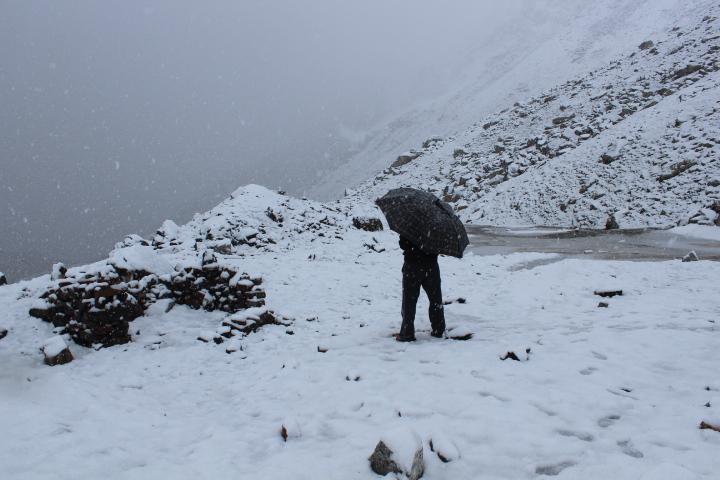
A fairly accurate representation of what we were faced with
Suddenly he stopped craning his neck, turned to us, smiled and nodded towards a ridge to our left. 

"Pathar dikh gaya"

He was pointing to a group of stones neatly arranged on top of each other, still strongly sticking up above the two feet of snow. The top-most stone was clearly pointed, placed there to show direction. The famed cairns, used and assiduously maintained by the mountain-folk for a situation just like this, would now lead us home. We quickly backtracked the little distance that we had gone down the wrong way, and trekked up towards the cairn.  From then on every sighting of the next set of stacked stones was further validation that we were on the right track towards dryness, civilization and all that good stuff. Remember that little game called Seven Stones that we played as a kid? That game will never be the same again. 

Weighed down by almost three extra kgs of wetness, we trudged along with the overall objectives of losing altitude and getting below the snow line, which seemed to have gone all the way down to almost 12, 000 feet. The path was wet and slippery, but at least we were not fighting gravity anymore so the physical effort was restricted to the carrying of our backpack. Half-walking, half-sliding down our increasingly more visible path, we first cleared the snow line, and then finally saw a familiar sight that we all remembered very well from our onward journey. 

The river.
                                                                    *                             *                              *

We woke up to wet grass and our first instance of bed tea (i.e tea before teeth-brushing) in the Ruing meadows on Day 3. The night's sleep had been sporadic - the rain had been clearly audible on the tightly stretched covers of our tents all through the night, and any impact sounds quite loud inside an enclosure of four feet by six feet. Nonetheless, everyone set off bright and chirpy on a glorious, sunny day towards our next destination - Dronagiri.

The path from Ruing to Dronagiri was for the most part 'standard trekking fair'. The single-person path wound its way around mountains while gaining altitude very gently. Basically (because every sentence begins with a basically), it was going to be like batting through overs 20-35 in an ODI game - keep the scoreboard ticking and don't do anything silly. There was apparently enough stamina and sensibility in the group to do just that, and we reached the lone proceed-with-caution part of this leg in good time. This part was known as The Landslide.

The Landslide - A very WYSIWYG name
The deal with the landslide, if you haven't already guessed, was that there was a huge landslide at some point in time. Unfortunately this landslide occurred right across the path to Dronagiri, which is of course, annoying. Therefore what does one do? Well, one walks right across the landslide by the same path, of course, because it would take far too long to go around the mountain. So that's just what we did, slipping and sliding across mostly loose rocks on a thirty-degree incline for the same reason that the chicken crossed the road. To get to the other side. Very impressively for all of us, we made it again with the minimum of fuss.

On the other side, in all its mountain-enclosed glory, was the village of Dronagiri. Legend has it that those mountains were the remnants of the mountain that Lord Hanuman took to Lanka during the Ramayana. The medicinal value of our surroundings, coupled with the fact that we got permission to stay in the solid structure that had been built on the outskirts of the village for trekkers, had us hoping that we would get some good sleep for that night. That and the fact that we had done as much physical work in a day as we would have in a whole week of our collective lives meant that all we had to ensure was that we climb high before sleeping low so that the altitude issue was taken care of. So we sauntered up with the mules into the surrounding mountains before retiring for the night.

Chilling with the mules
The night at Dronagiri was a wet and thunderous one as well, but possibly because we were inside a steel and concrete structure this time, everyone seemed to have got a reasonably solid night's sleep. This was important, because we had to start quite early on that cold, misty Day 4 morning to get to The River. We were politely informed by our trek leader that the later it got in the day, the more the snow melted and the more the river rose. Needless to say, there would be no bridge across this river. So, if we could all please wake up early so that we were not swept away by ice-cold water. Fair enough. Heading off 'early' at 8AM (after planning for a 7AM start), we still made it on the scheduled time of 10AM at the river. Mostly because Geology 101 was in our favour and we had to walk downhill to the valley floor to get to the river. Along the way, we also had some practice streams to cross, just to check our footing, capacity to bear cold and overall familiarity with gushing, freezing water.

About 1/10th the size of The River which was coming up.
The River, when we finally got to it, appeared truly massive for sure, but not full by any stretch of imagination. It was flowing along in split-up streams, with patches of rock like above in between to take a break during The Crossing. It was suggested that we go barefoot across the river, to avoid plodding along in damp shoes for the next six hours. This would normally be a great idea and everything, except that this river was at approximately minus 100 degrees temperature and it didn't have a sand bed. It had a stone bed. On the plus side, there would be no illegal sand quarrying on this river.

No sand here, no sir.
 As soon as we stepped into the river, we lost our toes. Not literally, but they were definitely not under any neural control of our respective legs, such was the cold. We formed a human chain and were 'helping' each other across the river, but mostly we were hanging on to each other for dear life. Slipping and falling on one's arse was simply not an option, the river was not kind to human contact of any form. We moved from rock island to rock island, wading through knee-deep water and feeling blindly for the next stepping stone on the riverbed with our non-responsive toes. The crossing took a solid hour before we finally reached the other bank, where we all settled down for a session of Kill-Bill style 'Wiggle your left toe' to try and recover our toes. It was largely unsuccesful.

Wiggling our left toes
Post-river, our route started climbing straight up to the Bagini glacier. This was the longest and steepest day by far, with an altitude gain of 1000 meters on the day and a total distance of 12 km. The path took us straight up the Himalayas with mighty, snow-covered ranges revealing themselves every time we crested each consecutive mountain. As the day wore on, we had to start battling two factors - the fatigue and the impending darkness. The physical effort was starting to show on all of us and the impact of the river on the toes was not helping. Every consecutive ascent we came up against took progressively longer for us to cross, and daylight was rapidly fading. As is evidenced by the lack of photographic evidence for this section, we weren't really stopping and enjoying the view at this point. The situation wasn't helped by the ominous dark clouds that were increasing in the skies with every step. We finally came upon a particularly steep ascent, which we were informed would be our last one before we would reach our camping spot for the night.

With our last remaining reserves of will (which was all that was keeping us going, the energy had long since ebbed away), we crested this final ascent to emerge on to our Base Camp for the night at 14,500 feet. We had just half-Everested, if that was any achievement. It was suitably cold for the height, and there were multiple snow-covered peaks all within literally touching distance now, rising majestically to our left. To our right was the glacier - a stream of ice and rock just sitting there unmoving, except occasionally when a large piece decided it had done enough handing about and just broke off. It was a sight to behold, as we were to find out later in daylight, but we did not have the time to behold it just then. For just as we reached the meadow hoping for some rest, it started raining.

This was the night of June 15th.

Friday, July 12, 2013

What goes up, must come down - Part I

"Yahaan raastha hi nahin dikh raha"

My heart skipped a beat. The usually inscrutable face of our guide (and 'Man of Steel' award winner) Kunwar Singh now had a nervous smile as he said these words. He wasn't kidding. He really couldn't make out where our path was.

I looked around. All I could see was white with some spots of brown - places where the mountain still had the might to raise itself over the 6 inches of snow that had been falling over the last forty hours. The same snow that we were trudging through at that time, walking down from a glacier to hopefully warmer, drier climes. It was a beautiful, picturesque, DSLR-worthy scenery - as long as it was viewed from hundreds of kilometers away and thousands of feet lower in altitude. When you are right there, facing it head on, it's an entirely different story.

Those picturesque snow-capped mountains. Up close and personal.
This is it, I thought to myself, this is the point where we become a movie script. Hopefully with a happy ending.
                         
                                            *                            *                             *                                 *

Six days ago, our motley crew of about 14 people had flown in from practically every major metro of the country into Delhi to begin our trek up to the Bagini glacier -14,500 feet above sea level. From Delhi, we took a much delayed overnight bus to Haridwar with a driver who insisted on regaling us with the complete works of Beethoven on his horn throughout the journey. All through the bloody night. The only time he stopped honking was at check posts, where the lights were bright enough to take over the job of keeping a person awake, as well as making them wonder what power crisis everyone was on about. As an aside, the good people of Delhi now use the pillars that hold up their groundbreaking Metro as landmarks. So next time you hear 'near No. 7' when you are in Delhi, look for the nearest Delhi Metro pillar with the No. 7 on it, and not some house number.

Blaring horns and metro pillars later, we finally reached Haridwar where our group of intrepid trekkers piled into two Maxi Vans - the preferred mode of transport in the mountain terrains - and headed to Joshimath. This was the first 'official' day of our trek but we still had the help of mechanized transport and other comforts such as regular food breaks. Given that our driver insisted on using every bit of the winding mountain roads 'and a bit more', to quote Steve Slater, the drive alongside the Alakananda sped by without a moment of boredom, pun intended. We reached Joshimath just before dark, to settle into our beds for our last night of sleep in a solid structure for the next five days.

We woke up the next morning to the bright, mountain sun and to being in the clouds. It was also around that point that we realized we were now truly in among the mountains. Because really, it is quite hard to miss mountains. They are right there, and they are quite big. And they are all around you, all the time.

The mountains. Just, there, all the time.
Once we got over the whole mountain-awe, we finally set out to actually climb a few of them. We were still not physically tested straightaway, as the day began with another short drive to Jumma over roads built by the intrepid BRO. Jumma is basically a bus stop, which leads to a bridge, which crosses a very fast flowing Dhauliganga river. We finally alighted from our mechanized transport at this point and felt the weight of our backpack / survival kit on our shoulders for the first time. Six days  later, I would get so used to the weight that I overbalanced and stumbled forward for the first few times that I walked without the backpack.

The first steps of the real trek was a fairly steep descent (as it seemed then. Now of course, I could go down it blindfolded while juggling three crystal balls) down to the river to cross a suspension bridge. A couple of slips on that descent and an encounter with what shall henceforth be known as the 'itchy leaves' were enough to convince me that sh*t just got real. Once across the bridge, we started on the trail to Ruing, a little village nestled halfway up the mountain. This was a 3km trek which is done by the locals on a weekly basis and should really be no biggie, but which was a good enough start for the bunch of novices that we were. For the most part, the track was well within control for the fit, young people that we were, but there were of course stretches where you wished you had taken the advice to do practice walks on a 45-degree incline. Such as these...

Road to Ruin(g)
Nonetheless, the 3km was covered without incident and apparently in really good time, as we were informed by Sandeep, our trek leader. Very proud of ourselves for this accomplishment, we poked about for a while in the meadows of Ruing and soon enough, got our first look at the tents which had been magically set up by people far more competent than us. Satisfied that we now had a green, plastic roof over our heads, we wandered off some more towards the more scenic spots of the meadow and soaked in the serene calmness of the whole scene. There is something to be said about watching a river which has been flowing through the same spot for centuries on end, incessantly carving a path for itself without stopping for night, day or the cow in the middle of the road (if it was a Chennai road).

Incessant. It's the only word.

The rest of the evening was spent staring down at this river, and staring up at the stars. There were millions of them, revealed in their full glory without the constant smog of the cities' pollution to cover them up, leading to more philosophizing about how insignificant the individual is and other such good stuff. By the time we were ready to retire on the clear, cool night, the trip had already become worth it. But of course, we had only just begun...

Monday, January 28, 2013

Once Upon a Time in America

It's been nearly twenty months in the US now. I have not got to the stage where there are multiple occasions when I think to myself 'Last year this time, I was...', which is an obvious sign of longevity. Besides, having just experienced my first power outage in the US, I feel like I have now seen everything. From a domestic sense that is, not from a Vegas-Miami-Night To Remember sense. Or even a Grand Canyon-Statue of Liberty-Thomas Cook Tours sense. But from a Make Lunch-Launder Clothes-Watch Football for most weekends sense. And here's what has happened....

The first (and easiest) thing one gets used to is the standardization. Standardization means that you only need to get used to an activity once, and you can be certain that that you can follow the same steps the next time you do it. It's why you can land at any airport and look for signs to the same transport options out - rental car being the most popular by miles (pun unintended) and the most standardized. That means you don't have to know how to haggle for the auto in Chennai. Or that the cab is more popular than the auto in Mumbai. Or that Bangalore may or may not have a prepaid auto option, depending on the weather and potential traffic situation in the city. Of course, the problem occurs when the standardization is not too easy to figure out, and no one understands the non-standard version. So I don't know what a Clipper No. 6 means, and my friendly neighbourhood Vietnamese haircut lady does not know what 'Medium, enough to comb' means. What the heck is comb anyway?

The second (and slightly more difficult) thing to get used to is that your relationship with the outdoors, and openness in general is restricted to parks or the beach. It's not like you can pop down to the potti kadai, get one Lay's Magic Masala packet for that Sunday afternoon craving and curl up by the window with your book.  Firstly, there's no Magic Masala, which sucks (come on Frito, missing a market here). Even if there was, you wouldn't get a small, one-serving packet. You will get a giant bag of potato, oil, salt and a sauce that goes on a 100 other foods as well. And last of all, there is no potti kadai. None. The best you can do is drive to a superstore, traverse an area half the size of Adyar and eventually give up and ask the assistant where to find some chips. By the time the whole ordeal is done, the afternoon has passed, you've lost your mood for the book and it's probably time to step out again. To run, or hike, or take DSLR photos. Because if you are outdoorsy in the US, you are either a runner or a photographer. Why else would you be outside! Which is the exact reaction I got during my first visit to a bank, where I had walked in the 100 degree Houston heat (yes, I referred to it in Fahrenheit, so sue me). It was a ten minute walk, but there was a freeway to cross. US visit tip: Don't 'cross' a freeway like it is Mount Road. Even under the freeway.

The third thing to get used to is time. Time, the same thing that gets stretched interminably in India, gets abused, not cared for, always assumed to not really mean what it actually says - that is very different. Of course we all know the Indian punctuality conundrum and how it is really difficult for us to wrap our heads around the fact that ten minutes later is actually a delay. But the more important timing changes are actually broader, and more regular. For example, lunch is at 11 AM. That's the time I'm usually brushing my teeth on weekends, but if you eat at that time 5 days a week, then you want to eat by then on weekends as well. And end up waking up on Saturday with a huge hunger pang. Then again, I'm also starting the work day at 7.45, so it's pretty fair to want to eat a big meal in about three hours. And of course, this cascades on to dinner times resulting in having 'supper' at 6.30. That is basically Aloo Bonda and chaaya time in India. So the stomach rebels for a while at this affront of having to eat a full sized meal at that time. Only for some time. After a while you stop questioning that 6.30 PM is the time to eat a full meal. Or asking '... and what else?' whenever someone offers 'salad' or 'sandwich' as a lunch option. So be it!

So here we are then. Twenty months and my biggest takeaways are potti kadais and aloo bonda, but they really are significant. I feel like I'm missing something from the whole Yoo Ess experience, but there's time yet to take some Patel pics, run the New York marathon, stand on the edge of the Grand Canyon, buy a DSLR camera...

Wednesday, February 15, 2012

Half-Baked Goods

Have you ever had those moments when some event, or some line, or some thought in your head felt like it could be your next great story? And then it just...


Should I wear this or the grey?, she thought to herself. The Grey, she decided, I feel like I should be inconspicuous tonight

"Hang a Louie", he drawled. I smiled and continued driving. "Aw, you missed it bro! I told you to hang a Louie" 

Sometimes I feel like there's a specific reason why the watchman at your local shopping center will make a huge deal of you parking your bike in a car space. I call it, The Theory of the Underemployed.

Doing anything in a group can be such a liberating thing, they both thought to themselves at the same moment, more than 8000 miles apart. While doing very different things.

And that night, for the first time in his life, he actually turned on a heater in his house.

The old man lit his cigarette, watching as the next stream of cars slowed to a stop at the signal. He put his banjo to his lips.


... and such things. I promise, one day, one of these will become a story.

Wednesday, December 21, 2011

Beautiful Thing


Never in a thousand years had I imagined that she would say that to me. 

We went back quite a long way, and she had always been the most beautiful thing I ever knew. I was hesitant to tell her that though, as I did not know how she would take it. It was just as well, better to be close to her, around her all the time than mess it all up with a moment of uncalled-for bravado. I was ok with that. It seemed for now, that she was too.

And yet here she was, sitting across from me, smiling radiantly as ever. My eyes were still tracing the upward curve of her lips, leading into those perfect cheekbones, before one splashed into her deep blue eyes. She must have seen me distracted because she was saying something again,

"I asked if you are coming for our girls' night-out. It'll be over at Katy's place, so it's practically a slumber party. It's gonna be..."

I must have been nodding along encouragingly. She kept going on about our night together in pajamas...

He suddenly realized he was still holding the phone, and she was still talking. How long had she been going on? What had he missed? Were they still talking about the same thing? What had they been talking about anyway? He tried to remember where he had lost track of the conversation. He started working backwards, with great difficulty, and arrived at a point where it looked like he had lost the plot. She had said something then, and he did not remember it. Something that had jerked him out of the conversation and into another plane. He even remembered thinking to himself, 

"Never in a thousand years had I imagined that she would say that to me"

Oh.

Saturday, December 10, 2011

Why the Sehwag double hundred feels different

For that very reason actually. That title sounds so natural. The Sehwag Double Hundred. Because there is a need to brand it. Because there's already one before him. That was the one that was only called 'The Double Hundred'. That deserved the definite article. It was something as yet undefined by anyone, so there was no need to brand it. Like how we just call it 'The Sun'. Not the Walmart Sun, you know?

In a way, it's sort of unfair to Sehwag. After all, this IS the highest score on the planet in ODIs. But, it remains just a refinement of an already accomplished effort. The response to the double hundred itself was distinct. From the crowd, from the commentators, everyone. Compare Ravi Shastri's 'First man on the planet to do it, and it's the Superman from India' to Siva's 'Has he got it through the gap? Is it another four? Oh what a good shot... Oh hang on he's got 200 too!'. I'm exaggerating of course, but the focus itself was not on the 200 anymore but how fast he had got there, how everything had gone right for him etc.

And that's the second part that's been unfair to Sehwag. A lot has been written and said about his see-ball-hit-ball philosophy and his blank mind and everything. It's unconventional yes, but also simple. To the point of being too simple in fact, that it's not exhilarating anymore. When Sehwag reduces it to just two actions, everyone thinks 'oh yes of course, now it all makes sense'. And we all rejoice in how easy it is, and how effortlessly he does it. 

But human inclination is to celebrate the skill that it does not yet understand, and watch a master of the skill perspire his way to it. In all of what I consider Sachin's three greatest innings - vs Australia (the qualifier), Sharjah; vs Pakistan, Centurion; vs South Africa, Gwalior - the most enduring images have been of Sachin puffing/cramping/puffing & cramping. Contrast that to Sehwag's effortless coast to the 200, and then some more. One is a master painstaking working his way to an art, the other is doing a 9-5 job. One is a butcher, the other a sculptor. The act is the same, but the art, not so much.

In many ways, the first double hundred just ran to a perfect script. The 200 didn't come till the last over,. There was the incredulity of whether the country's favourite captain would deny the favourite son just because he was dealing only in boundaries. Surely after coming all the way to 199, where he seemed to stay for about an eternity, he wouldn't be denied for lack of strike! Hashim Amla got perhaps the greatest cheer in an away ground for stopping a boundary. It was a perfect symphony of rising notes leading up to the crescendo. Like Tchaikovsky's 1812 Overture. Sehwag's innings on the other hand was like Pink Floyd's Echoes. A constant trip where you barely notice the high points, because you just want to keep tripping away...

Wednesday, April 27, 2011

Speed Racer

He knew he never had the straight-line speed to catch him. If it had to be done, it would have to be done on the braking. And soon, they were on the last lap.
“And Schumacher starts the final lap still in pursuit of Hakkinen. Will he finally be able to make this one count, or will the McLaren’s straight line speed keep him ahead till the chequered flag?”
He felt the sheer adrenalin making him sharper, more focused. He had been called the greatest driver of his times by many, and the greatest driver ever by a few but all of that was immaterial right now. He tightened the grip on the steering wheel and pushed himself deeper into his seat by a fraction of an inch. That’s what this sport was decided on, fractions of inches.
“We turn into Beckett’s now, the series of long, sweeping left-handers that will suit the Ferrari’s balanced chassis. Can Schumacher gain ground here?”
He knew this circuit like the back of his hand. He could drive it single-handed through blinding rain, and had actually done it a few times as well. He went along the same route so many times that he knew exactly where to brake late, where to move that fraction of an inch closer to the edge of the road, where the upward slope was so that he could get on the accelerator early…
“Coming up to the first intermediate marker here, and Schumacher’s first sector time is faster than Hakkinen’s! He’s gaining here surely. Not by a lot, but he’s definitely gaining.”
He hated that his car was not just simply faster, and he had to drive his way out of this if he was to win it. But then again, wasn’t that what great sportsmen were made of. If everything was set for you- the best car, the best team, the best conditions, then what was to differentiate you from anyone else who got those. Thus consoling himself, he screwed his eyes closer and leaned forward ever so slightly, as if egging the car forward. The grip got harder still, the seat was pressing against his back now more than he was pressing against it and the legs had practically become welded to the gas and brake pedals. He was as close to being one with the car as he ever could be. As close to Nirvana.
“We’re past the second intermediate and it’s still anybody’s race. There’s barely half a second in this one now, and we are not making any calls. Hold on to your hats folks, this one’s going all the way to the last corner”
This was it now, he knew it. The last chicane, the sharp left-right before they floored their pedal to the finish line. He braked really late, as if making a move for the inside of the left turn. Predictably, the car in front defended, closing the inside line and leaving him no room to move. But then, he had known that. He hadn’t done 25000kms in a vehicle to forget the basic rule of racing, ‘Always defend your inside line’. He turned sharply right, simultaneously accelerating hard even while turning. A cardinal sin of course, but what the heck. He was now on the outside of the car in front, but more importantly, on the inside for the upcoming right. He practically stood on his brakes for the right turn, perfectly clipped the edge of the kerb to make the racing line and gave a quick glance towards his left. He could see the nose of the McLaren, in line with his seat. This was it!
“And Schumacher’s just pulled off the most amazing move! All the way around the outside on the left turn before diving inside for the final corner and flooring it all the way to the finish line. What. A. Finish!”
* * * *

There she was, in her usual seat next to the CEO’s office. She looked up, flashed him that brilliant smile of hers and asked, “You’re in a bit early today, aren’t you?”

He smiled back and nodded. Then, still smiling, he made his way to his desk, the noise from the grandstands still ringing in his ears.

It had been another record-breaking lap from his house to office.

Wednesday, February 16, 2011

TwitteRant

Firstly let me clarify that this has been long due. That it has not seen the light of day can be attributed to various reasons, not least of which is paradoxically one of the things this post seeks to address. And thankfully, now that I've got my customary long sentence out of the way, I can get down to business.

Unless you've been living under a rock or, in massive over-preparation for 2012, in an ABC shelter, you cannot have missed the internet phenomenon that is Twitter. I was about to prefix that with 'latest' when I caught myself, realizing that in the digital world, Twitter is about as latest as the chubby Ronaldo is to football and the Pterodactyl is to the earth. Either way, your life has been touched by #twitter at least once. I am among the last of the muggles left in Twitter-warts magic school, simply failing to understand how a medium that needs such constant attention and allows no room for flowing, liberal prose could ever be such a popular medium of expression.

It's not that I don't like the concept itself, it's just that somehow I feel, it's no different from those big ol' public chat-rooms that Yahoo had. For me, twitter is like the Chennai Central station - as soon as I enter it, I just get swamped by this incessant buzz of chatter, each with their own voices and opinions and all talking at once. Similarly, most twitter conversations which go @reply after @reply after @reply seem like the chubby, late-middle-aged bureaucrat or businessman in a Safari next to you talking loudly into his phone forcing one side of the conversation completely upon you.

And what is this about joining the conversation. Most of the times the conversations fly by so thick and fast that I barely get to comprehend what's going on, let alone get a word in. Apparently there's 'clients' and 'apps' which can read your brain, paraphrase it in 140 characters, throw in a few links and hashtags and announce it to the world within 10 seconds. I, on the other hand, lose about 2 minutes just trying to see which @ I should reply to, and then thinking about the line which will best pack a 140-character punch. By then, the topic of discussion would have moved on entirely about thrice, rendering you clever, thoughtful and brilliant insights kinda 'old school'. Damn.

"If you know so much, you must be using it, Aha!" you say. I am, but it's mostly in such a passive state that bears in hibernation will have a longer timeline than mine. Mostly I'm just scared that I will break some unwritten rule in the flurry of all the @ and #s. Is it ok to address a guy you completely don't know as 'mate'? Should I ask for people's permission before @mentioning them? And seriously, what's the deal with celebrities?!! Questions to which deriving the answers from the iterations of my moral compass result in the same lack of alacrity as mentioned above. And on twitter, alacrity is everything.

As far as I see it, it has been most successful as a news dissemination medium, which is quite different from what it allegedly started out being. By the sheer strength of crowd-sourcing, it's been able to pull together stories from all over the world in a way no news agency can, and for that it works. Imagine a current affairs wikipedia, constantly edited and getting filled with some useful information by a modification of the Infinite Monkey theorem. And the power of customization letting you choose which parts of infinity you want to read, right here right now. Well, that's all just fair. I guess some of us would still like to wait for a more informed, thoughtful opinion in the next day's papers.

What do you think? Feel free to drop me a line on twitter @Duckyied and I'll be sure to get back to you. By 2013.

Or you can just leave a comment below.

Thursday, September 16, 2010

Phase I


(00:02)
Amit leaned across from his desk and dialed the number he dialed every day at precisely this time in the evening-The Goldilocks zone, when everyone required for the discussion across all time zones was awake and fresh. His fingers flew over the numbers on the phone and he stared absently at his screen as he waited for the cheery ‘Hello’ to interrupt the ringing tone.

He sat up straight and stared into the darkness in front of him. He was sure he was seeing the colours of his wall painting dripping from their canvas onto the floor. He was also sure he wasn’t. And what of that smell? There was no reason for that smell to penetrate his nostrils, where he was. But it was! This inherent mistrust of his own senses made him question whether to believe the message that the next of his senses was conveying- that noise! He reached for the button which he vaguely remembered stopped that noise. Ah, Silence.

(06:11)
The connection was being really bad today. It always happened on trans-Atlantic phone conversations, irrespective of the amount of progress that the telecommunications industry had made over the past few years. The person at the other end wasn’t helping either, with his constant mumbling. Amit looked at the clock and sighed. It had been more than 5 minutes and they hadn’t really got closure on the first issue they had been discussing. He sighed, forced himself to concentrate on the call and strained his ears to hear better.

He opened his eyes and let his mind register the dim light illuminating the room. He smiled to himself as he thought how just a single light was enough to dispel any amount of darkness. Amount of darkness? Was darkness quantifiable? For that matter, was light quantifiable? He remembered a conversation he had had a few days ago...
“What’s that?”
“It’s a lava lamp man. That’s electric arcs streaking inside”
“Sweet. How does it work?”
“So if you touch it, your fingers create the potential difference, and the electric arcs converge to it”
“Nice. But you should be able to control it remotely too”
“How?”
“With your eyes. Light is a particle right? So if you stare at it long enough, or hard enough, you should get enough light particles on the lamp to create that potential?”
“Yeah... no. Your eyes don’t emit light. They absorb them.”
"Ah. Damn”

(08:23)
Amit was beginning to wish the emotional baseline of this conversation was a little flatter. The caller had gone from monotonous mumbling to quite an excited state, even agitated. The deadlines were close and they had closed only one of the five issues they had to discuss. He didn’t like it when he had unclear issues on his hand; it messed up his mental plan. And he didn’t work well with messed up plans. He was getting increasingly impatient for his turn to speak, he was barely getting a word in right now.

He forced himself to shift his body into a vertical position. He knew he had accomplished that task when he saw himself staring at the painting again, as opposed to the ceiling that he had been staring at for the last ten minutes. The room was beginning to feel stuffy too, all of a sudden. It was so hot in there... No wait, it was actually cold. Nope, hot again. It was being... groovy. Either way he had to get out of the room but he just couldn’t make himself. He was beginning to feel mildly perturbed. Surely he should be able to get out of this room? Of course he could. As soon as he could get up.

(11:33)
Amit was relieved the call was coming to an end. They had clarified all that he wanted cleared up, though he was not sure about the confidence level of the person at the other end of the line. He wasn’t going to be unduly worried about that, he wanted to get home as soon as he could today. It was his son’s 5th birthday, and he had already missed the 4th birthday party because he was off on official business. He paused long enough to make sure that the person at the other end had nothing more to say as well, and then ended the call with his usual farewell message, “Alright then, Goodbye, Brian”

He rolled over and as if like a trained response, hit the button that he always did when he heard that phrase. Apparently it ended something...

Brian’s rocky journey ended twelve hours after it had so innocently begun. He was shattered by it...

Friday, August 27, 2010

CWG 'shame' is fine, but what about daily life?

The last three months have seen cringe-worthy behaviour from all fields of our beautiful, huge, over-populated, 'developing' country. First the sports bodies involved with the Commonwealth Games, then the beauracracy involved with the sports bodies, and on top of it all, the press involved with all of the above, who outdid each other in claiming the 'first to have unearthed the scam'. Clap clap, congrats to you, you are up for the upcoming Peace Nobel for this monumental achievement. News seems to be the new entertainment - always on, unearthing 'breaking stories' hour after hour involving oil spills, games scams and Deepika Padukone's cat getting stuck up a tree. This arrival of 24x7 media hasn't exactly helped the world I feel, but that's a debate for another post.

So, as I was saying, there has been approximately INR 20,000 crore siphoned off the games so far. I have no clue how to type the new Rupee symbol - a symbol which represents our arrival on the world stage, our economic clout, and in this case, our unending corruption. It's a crying shame that the first widespread use of the new symbol was when those news items about 'Treadmills for INR 10 Lakhs' were splashed all over the pages of one of the above 'we saw it first' media houses. Just goes to show, you can change the symbol, but you can't change the people.

So now, unlike Beijing and later South Africa, the hosting of a games has mostly pulled down any respect India gained over the last 10 years. It's just been a case of the Emperor's New Clothes all along, India Shining, India and China, Neo-liberalization, all other associated bullcrap. And while all the attention has been rightly focussed on this monumental mess up, I have one minor question to anyone who cares to listen - What about the smaller people and the smaller 'somethings' that are given everyday.

Here's a small experiment. Someone please tell me the exact fee, as laid down by the law, for:
  1. Getting a driver's licence from a state-established RTO.
  2. Changing registration/paying a state's road tax (I don't get why the heck Road Tax is a state subject in the first place, but again, I digress)
  3. Getting a passport, including that very famous step of 'police verification'
  4. Getting a birth/marriage certificate.
Rates aside, I have one other question for the list. Why does it take, and is accepted as the norm, for an Income Tax refund to come after 3 years of the year of Assesment? I mean, it's the age of the TDS and NEFT transfer. I should pay my taxes promptly before I even receive my salary, but if I have to get a refund I wait 3 years? Heck, I probably belong to a very small percentage of our Billion+ sweethearts who even pay the friggin tax at source. The least that can be done is settle my accounts at the end of every fiscal.

I guess my point is that unless we stop this 'thousand for this saaar', 'chief officer will also have to be satisfied saaar', 'it will take 3 months to get this signed, but I know a way it can be done quicker saaar' habit of ours in our daily life, practiced by a million people every day, there's no point losing sleep over all those crores that went down a few very fat pockets in Delhi. Between us, India's famed New Middle Class, would've hit the total amount of the scam over the course of barely 4 years of our lives. We really can't complain about someone thinking they can get away with doing it over 4 weeks.
Sigh.

Monday, June 14, 2010

Another bag - and a very strange look

In keeping with the usual Indian habit of not practicing what we preach, I almost stepped out yesterday to buy my breakfast items without a bag. Thankfully I was reminded of my preaching by my very alert roommate and I succesfully stepped out with what has now become my shopping cover (a plastic bag admittedly, but it is reuse!)

Note, this shop is different from the one in my previous post. It's smaller, family-run and less crowded than the retail chain. So with all required items purchased, I stepped up to the counter again. Again, just as the items were about to be bagged, I pulled out my own bag and presented it to the man. The look that I got from him at that moment was somewhere between what E.T got when it first landed on earth and the look that George.W.Bush has got throughout the time he has been on earth. In fact, if I weren't a regular customer, it seemed pretty sure he was going to label me crazy and chase me out of the shop.

If you're the logical type, it is an irrational act on many levels. I am saving them one bag, irrespective of how miniscule that cos saving is. This shop did not have any branding on its bag anyway, and neither did the bag that I took. Hence there is no marketing loss. And yet, from an anthropological perspective, it was a perfectly natural thing to do. It is called inertia. Or 'status quo' bias. I ticked him off so much simply by breaking his process of grabbing a fresh plastic bag from his stack, blowing it open, dumping the things inside... the whole line. I broke the process, with an 'unnatural' act, and hence it became extra effort for the person.

Any object at rest or motion will continue to remain in rest or motion unless acted upon by an external force...

Monday, June 07, 2010

I saved one plastic bag today

Every time I go to a retailer, I get the mandatory plastic bag in which to put the items I have purchased. This happens repetitively, the bag is in use for barely 20 minutes (walking back home for a maximum of 1km) and they all pile up in one shelf in my cupboard one after another. Hence, they are also annoying.

Today, when I had to buy a bunch of household essentials from the friendly neighbourhood retailer, this time I took my own bag. Or rather, a bag I'd got from the same friendly neighbourhood retailer just three days ago. When I reached the head of the counter and the cashier reached for the bag, I whipped out my white used bag from my pocket in my best Clint Eastwood impression. The man at the till looked at me quizzically, but there's of course no reason for him to reject my wish to use my own bag. And he duly filled 'er up and sent me on my way. The bag held for the 20 minute walk, got emptied in my house and went back into the shelf.

It isn't exactly an earth-saving act. It's one plastic bag less and that too for a very selfish reason of reducing the clutter in my cupboard. But if it has served the purpose it was meant to serve just as well as a new bag, and if I can use the same bag over at least 10 purchases, that's 9 less plastic bags in landfills like these:


Of course, I am now naturally inclined to get holier-then-thou and ask you to think about how much lesser bags there would be if each of us reduced 9 plastic bags from being used. Or use fancy terms like BYOB (Bring Your Own Bag) and expound upon the merits of doing that as well. Or tell you how we can even put that 1 bag out of use if we use a jute bag. However, I'll resist all those inclinations now. All that's for later. This post is only about what I did. And what I did was save one plastic bag today.

So what did you do today?

Saturday, May 08, 2010

The UID Project

Dear Mr. Nilekani,

Firstly, let me congratulate you for stepping back from the corporate world and consenting to take upon yourself the onerous task of accounting for every single one of our 1.3 Billion and growing population. As a 'giving back' step to society, it is very commendable and it also helps that you've picked what is definitely an area of expertise to give back in. Hopefully you can bring all of your expertise and know-how gained in the corporate world and see this project to completion successfully.

I remember when the UID project was announced and you were given special cabinet rank to execute it. I remember your interview over phone with Shereen Bahn on CNBC, not one on my regular-channels list admittedly. After that of course the project has been going on, as always happens with projects of this size and magnitude, at its own pace and time. And cost. So why am I suddenly reminded about this now?

The reason is because today, I got Uniquely IDed. A census officer came over to our place today as part of the National 2010 census, and also to collect details for the UID. And the whole experience left me with a lot of headaches about the management of the project, which I'm sure have crossed your mind as well and you are looking to solve. Still, as a concerned citizen, just my two penny worth of thoughts in what will finally give the Social Security number equivalent to all of us in this country.

Firstly, there are three of us living in a shared apartment - an undeniable feature of almost every house in a radius of 5kms from where I live. I'm sure the same is the case with houses in Bangalore, Chennai, Mumbai and every other city in this country. Most of us are temporary residents there with permanent addresses all given differently. In such a situation, is there going to be an effort to cross-reference people scattered over the country to the actual households they belong to? By permanent address or something would be the way to go I'd think?

The second issue is with the language. The officer who came around took down our names in the regional language. I'm sure there is going to be a lot of Lost in Translation occurring when these names are transliterated back into English for the UID. And I don't want any issues when the spelling on my UID does not match the spelling on my passport because someone made a typo at the data entry point.

Also I would apparently receive my UID from the local Corporation, 6 months down the line. What if I'm not in this Corporation 6 months down the line? And have surrendered my local phone number? It is the only means of contact that the Census officer has for all three of us in this house, since he took my name as 'head of the family' - another concept which cannot apply to shared residences like ours. Anyway yes. I'm now tied down to this city's Corporation for the Identity Proof which is supposedly trans-national and should be provided to ALL citizens of this country.

Those are just some of the issues that I, solely from my point of view, thought about. Expanding my line of thought to the logistics and data collection of the exercise throws up a lot more questions. For example, will the Database be able to cross-reference me and my father as belonging to the same family, though our census happened in different cities? How would it do this, considering the permanent address cannot be a unique key on which databases can be related. The census officer mentioned that he'd come around 5 times to a house. Even allowing that all visits are on weekends, that's about 5 visits over a month. It's quite likely that families are out on month-long vacations. Especially in the summer. Do they just get missed then?

I'm sure there are some issues among these which have been dismissed as inevitable. But there are some points where one wonders, can this not be done better. For example, there's already a huge database of unique Identifications in the form of the PAN card, especially among the salaried class. That's about 250 Million people that have been covered already, and there must be a way to sync that up with the census exercise. For the migrant issue, or the language issue, there's only so much care that can be taking I guess. But the point is, the painstaking and accurate part of the work has to come at this first point of data collection. And I somehow feel there should be a better way to structure this to avoid inaccuracies or double counts.

I guess that's why you're heading the project then, and not me. Because given enough manpower, I'm sure any educated Indian can get the rest of the process after the data collection right. It's to figure out how to get that part right, while ensuring it's not a mammoth time and cost exercise, that your experience comes in I guess. Well, I sure hope you can pull it off.

Regards.